Testing an AI agent is only half the job. The real challenge is making sure it learns from past mistakes instead of repeating them. Your team might fix a problem today, only to find the same issue returning a few days later. Repeated fixes take time, slow down development, and make it harder to trust your system.
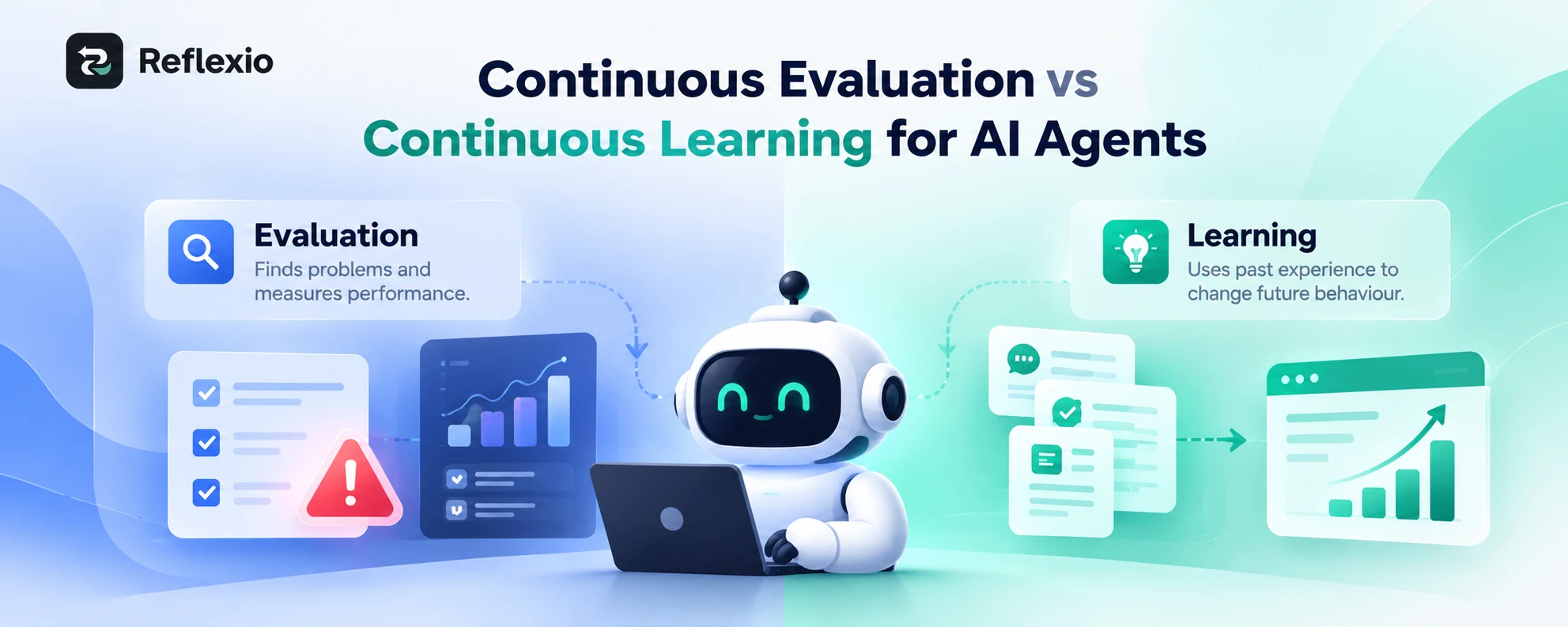
Continuous evaluation helps you find problems. Continuous learning helps turn experience into better future behaviour. Reflexio, an AI agent learning platform, connects these two ideas by turning corrections, failed attempts, and successful outcomes into useful lessons that agents can reuse.
What Does Continuous Evaluation Do?
Continuous evaluation means testing an AI agent regularly, both during development and after launch. For example, a customer support agent should:
- Give correct answers.
- Choose the right tools.
- Follow company rules.
- Complete tasks without unnecessary steps.
- Handle unusual requests correctly.
Checking only the final answer may not be enough. An agent might give the right answer after using the wrong tool or skipping an important check. Google Cloud's guide to continuous evaluation explains why teams need repeatable tests to find problems and track changes in agent performance. Evaluation shows what is working and what needs attention. However, it does not automatically teach the agent what to do differently next time.
What Does Continuous Learning Do?
Continuous learning helps an agent use past experience to change how it handles future tasks. Imagine a support agent gives a customer an outdated delivery estimate. A human corrects it and explains that delayed orders must be checked against the latest carrier update. A learning system can turn this experience into a useful lesson:
Before giving an estimate for a delayed order, check the latest carrier update.
The agent can then use that lesson when handling a similar request. This is the idea behind Reflexio. It helps agents learn from real interactions and reuse useful lessons instead of treating every task as a completely new experience.
Learning does not mean every mistake becomes a permanent rule. The lesson must be relevant to the future task, and the team should still check whether it improves results. It also does not require retraining the underlying AI model after every interaction.
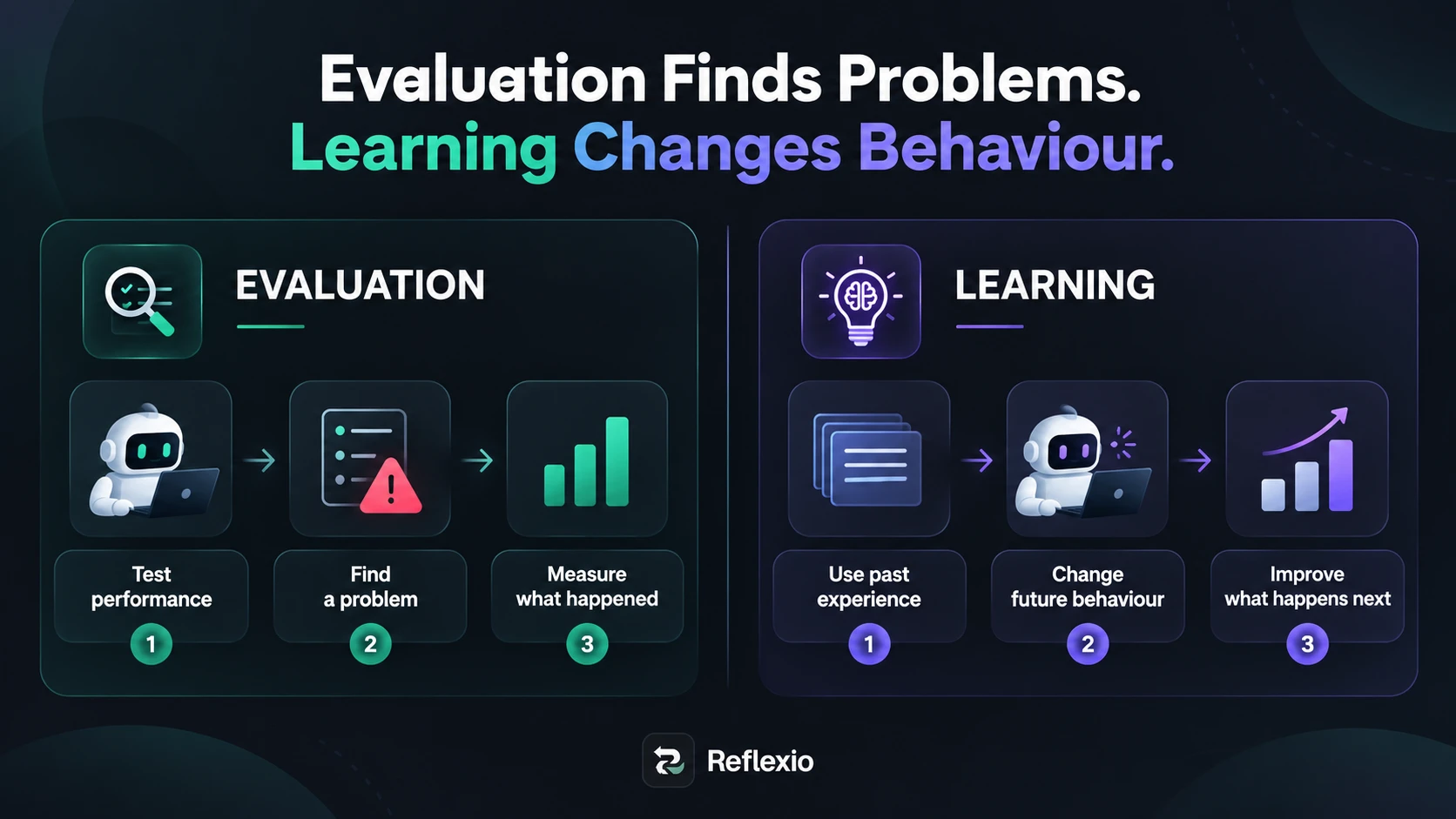
Evaluation vs Learning: What Is the Difference?
| Continuous evaluation | Continuous learning |
| Checks agent performance | Helps change future behaviour |
| Finds problems and patterns | Turns useful experience into lessons |
| Answers, “What went wrong?” | Answers, “What should change next time?” |
| Measures results | Supports behaviour improvement |
For example, a coding agent may repeatedly change a file without checking how it affects other files. Evaluation can show how often this causes errors. Learning can help the agent reuse a lesson to check related code before making changes.
You still need to test the agent after applying the lesson. Otherwise, you cannot know whether it helped. Memory is different, too. Memory stores information, while learning helps an agent use experience to change its behaviour. Read more about AI agent memory vs learning.
How Do You Turn Evaluation Results Into Learning?
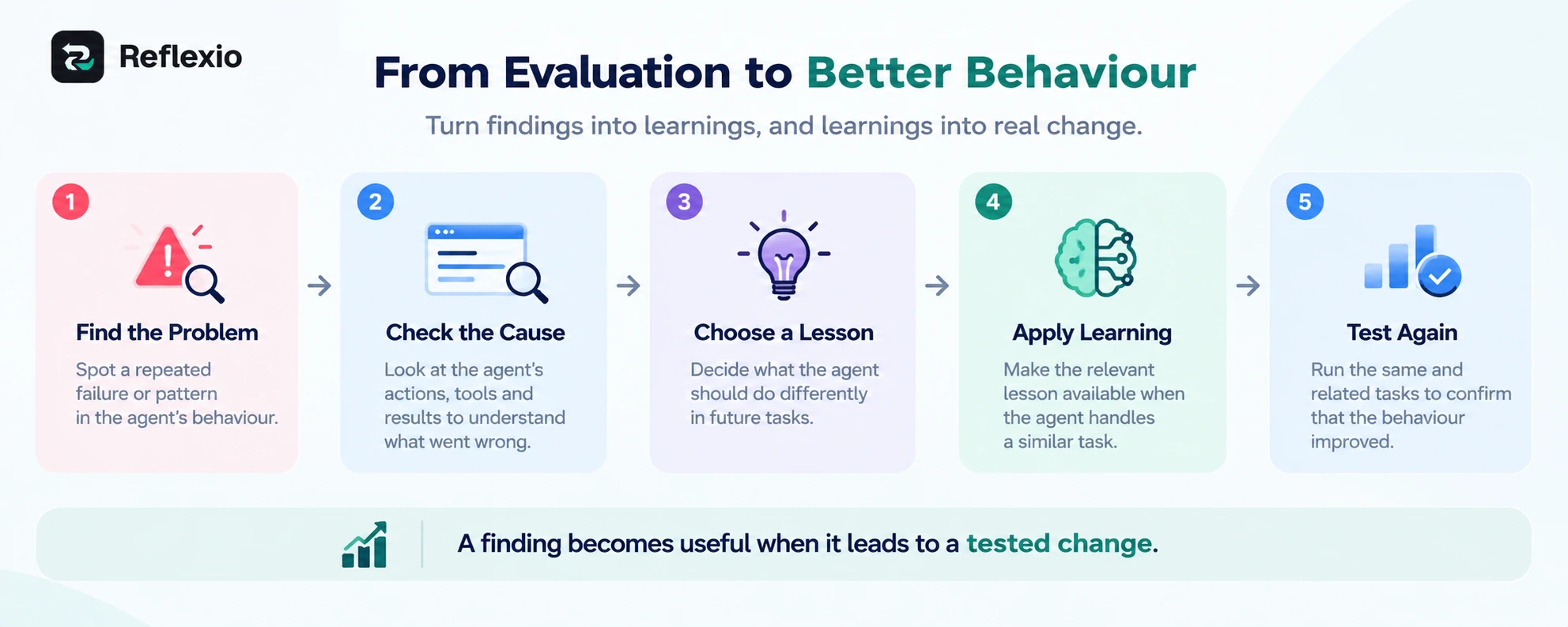
Finding a problem is only the first step. You must understand why it happened and decide what should change. Follow this process:
Step 1: Find a repeated problem. Look for failures that appear across similar tasks rather than treating every unusual result as a pattern.
Step 2: Find the cause. Review the agent's actions, tool calls, and results. Did it miss a rule, use outdated information, or receive incorrect data?
Step 3: Choose the right fix. A broken tool needs a technical fix. A repeated behaviour problem may benefit from a reusable lesson.
Step 4: Apply the lesson. Make the useful learning available when the agent handles a similar task again.
Step 5: Test the result. Repeat the original test and check related tasks. Confirm that the agent improved without creating new problems.
Anthropic's guide to evaluating AI agents explains why checking an agent's actions and intermediate steps can reveal problems that a final-answer check may miss.
How Reflexio Helps Agents Learn From Experience
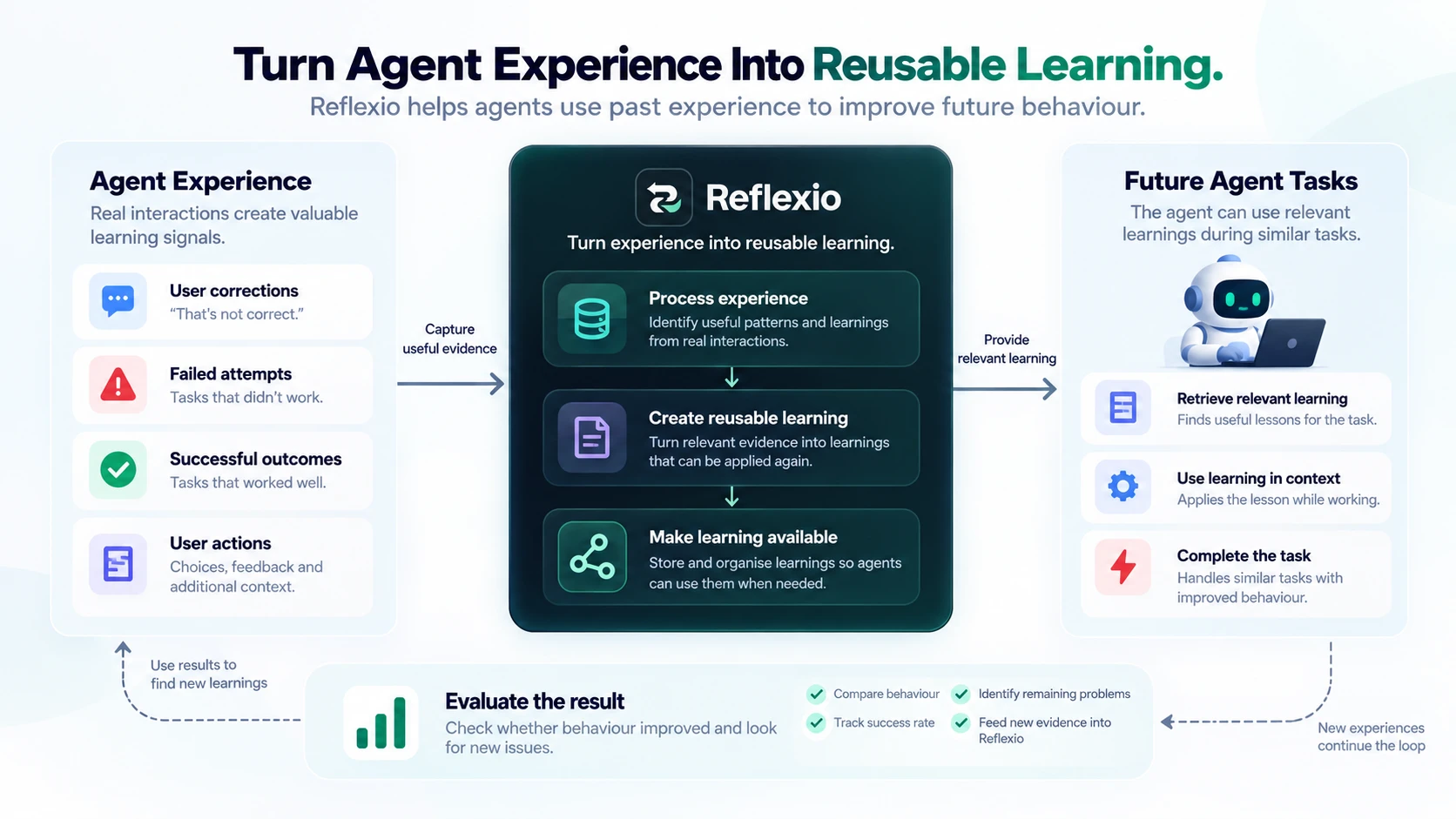
Teams may already collect logs, test results, and customer feedback. But collecting information does not guarantee that an agent will use it to improve future behaviour. Reflexio helps turn agent experience into reusable learning. The process works like this:
- Capture experience: Send relevant agent interactions, corrections, feedback, and outcomes to Reflexio.
- Create useful learning: Process the experience to identify lessons that may help in future tasks.
- Reuse relevant lessons: Make those lessons available when the agent handles similar work.
- Check the impact: Use your evaluation process to see whether behaviour improves.
The Reflexio interaction documentation explains how interactions and user actions can be sent into the system as learning signals. For example, if a research agent repeatedly uses outdated sources, the team can investigate the cause and create a lesson about checking publication dates. Reflexio can help make that lesson available for future tasks.
Reflexio does not replace evaluation. It supports the learning process, while tests and production checks help you confirm whether the change worked.
How Do You Know Whether Learning Worked?
The number of lessons an agent creates does not prove that it is improving. What matters is whether its behaviour changes in a useful way. Check four things:
- Fewer repeated mistakes: Does the original problem happen less often?
- Better results: Does the agent complete more tasks correctly?
- Lasting improvement: Does the change work across several similar tasks?
- Fewer unwanted effects: Has the change caused problems elsewhere?
Keep the original failure as a repeatable test. Then test related cases to see whether the lesson works beyond one example. AWS provides Agent-EvalKit, an open-source toolkit for evaluating agents using test cases and reports. If results improve, keep monitoring them. If the problem remains, review the lesson or investigate another cause.
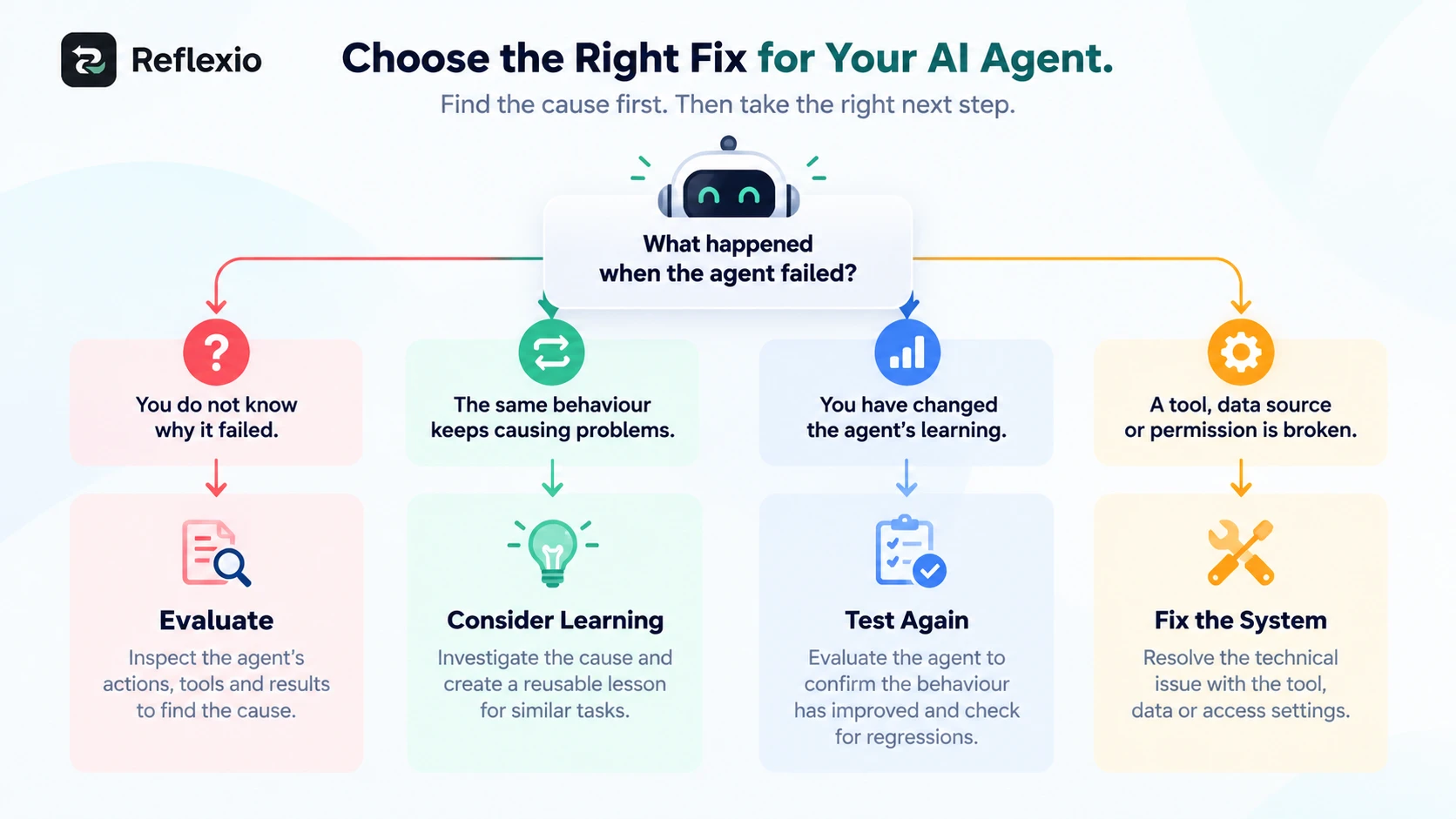
When Should You Evaluate, Learn, or Fix the System?
| Situation | What to do |
| You do not know why the agent failed | Evaluate and investigate |
| The same behaviour keeps causing problems | Consider a reusable lesson |
| You have changed the agent's learning | Evaluate again |
| A new problem appears after a change | Check for regressions |
| A tool or data source is broken | Fix the technical issue |
Learning is not the answer to every problem. If an API returns incorrect data or the agent lacks permission to use a tool, fix the underlying issue first.
Evaluation Finds the Problem. Learning Changes What Happens Next.
Reliable AI agents need more than good test results. They need ways to learn from useful experience and avoid repeating mistakes.
Continuous evaluation shows where an agent is struggling. Continuous learning helps it use past experience to improve future behaviour. Reflexio helps bridge the gap by turning real agent interactions into reusable learning. Combined with regular evaluation, it gives teams a practical way to work towards better agent behaviour over time.
Explore Reflexio to learn how your agents can use past experience to improve future tasks.