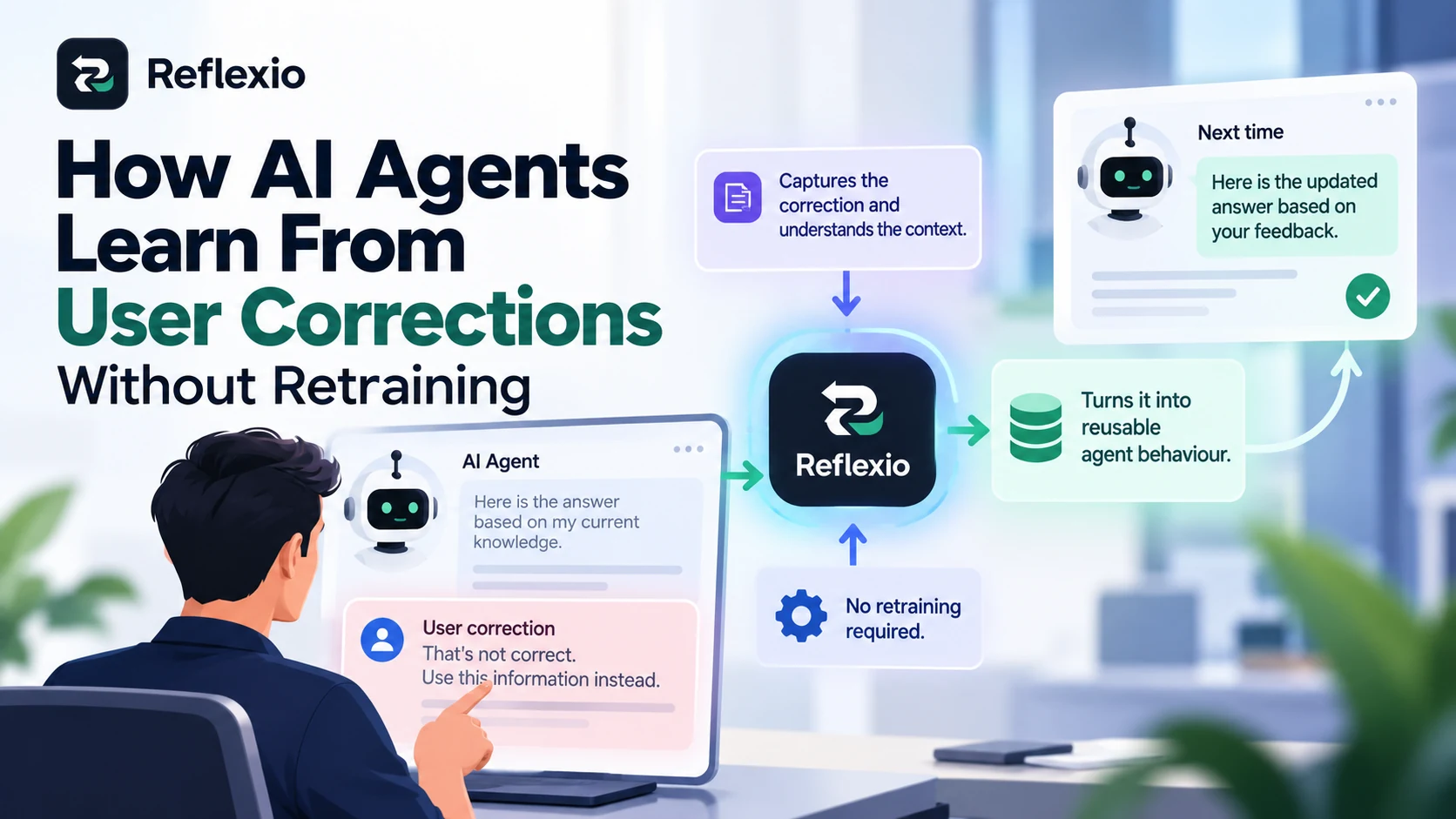
An AI agent gives the wrong answer. You correct it.
It fixes the answer, finishes the task, and the conversation ends.
Then the same problem happens again tomorrow.
The agent makes the same mistake with another user.
This is one of the biggest problems with AI agents in production. The agent can respond to feedback in the moment, but that does not mean it has learned from the experience.
The result is costly. Users keep correcting the same mistakes. Support teams repeat the same fixes. Developers keep editing prompts. And the agent never seems to get better from the work it has already done. The real question is not whether an AI agent can accept feedback. It is:
How can an AI agent learn from corrections and use that learning the next time a similar task appears?
The answer does not always require retraining the model.
Why user corrections disappear after an interaction
Most AI agents have access to the current conversation. Some also have memory systems that store past information. But remembering an event is different from learning a new way to behave. Imagine a support agent handles a payment issue.
A customer says:
“There is a $49.99 charge on my card that I don't recognize.”
The agent checks one transaction and replies:
“I've refunded the $49.99 charge.”
The customer then says:
“There is also a $9.99 one.”
The agent may fix the current conversation.
But unless that correction is turned into something reusable, the next customer can receive the same poor response. A useful learning would be:
Before resolving an unfamiliar charge, check the full recent transaction window and identify all related charges first.
That is more useful than simply saving the original conversation. The first tells the agent what happened. The second tells it what to do differently next time. This is the key difference between AI agent memory and learning.
What does an AI agent learning from corrections look like?
A useful learning loop has several steps.
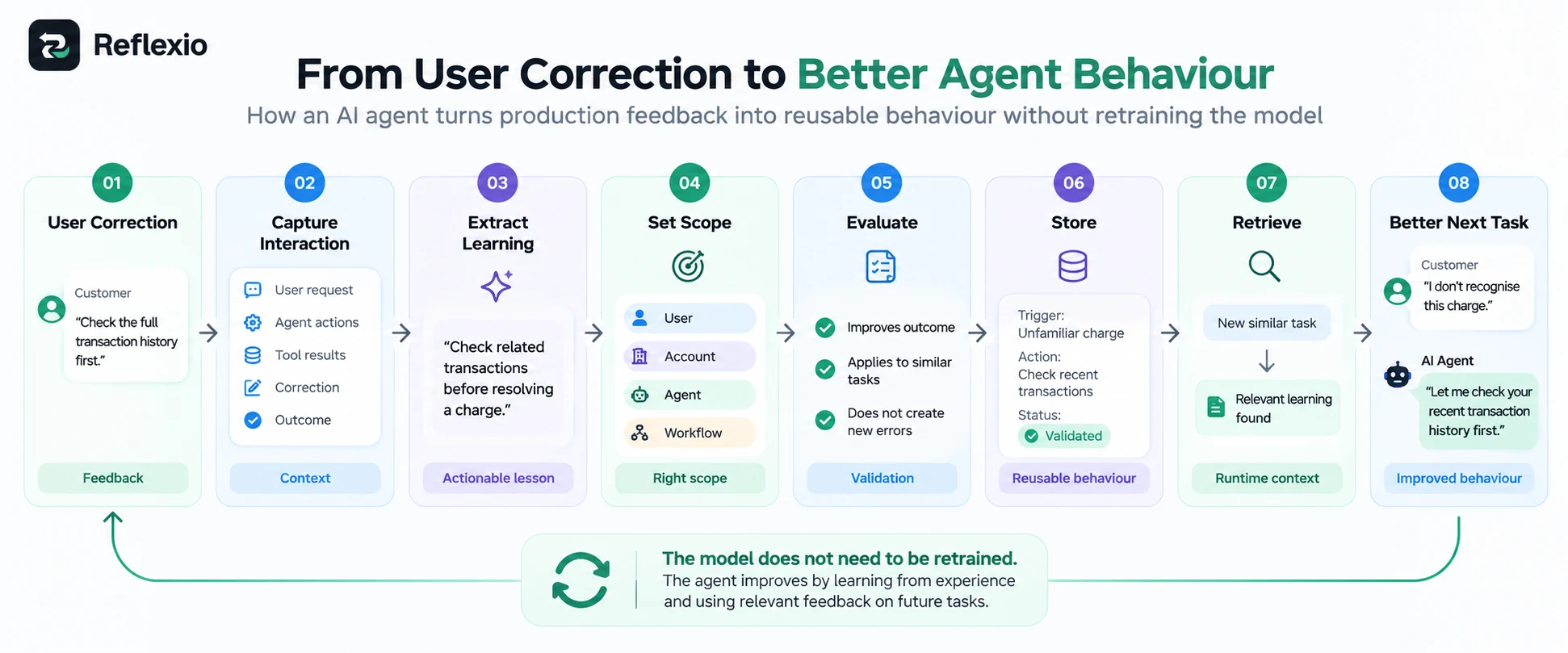
1. Capture what happened
Start with the full interaction, not just the final correction. A useful record can include:
- The user's request
- The agent's response
- Actions taken by the agent
- Tools it called
- Tool results
- Errors or failed steps
- User corrections
- Final outcome
This gives the system enough context to understand why the correction happened. For example, a coding agent might say that a bug is fixed. The user replies:
“Did you actually run the test? Check the server log before saying it works.”
The useful signal is not simply: The user likes tests.
The stronger learning is:
When fixing code, verify the change before claiming the task is complete. Use tests, build output, or runtime logs based on the type of failure.
Effective feedback collection mechanisms can capture human edits, approvals and corrections and use them to improve agent behaviour over time. Incorporating human feedback is therefore an important part of building reliable agentic AI systems.
2. Turn the correction into a useful learning
The next step is to turn the interaction into a small piece of behavioural guidance. Think of it as moving from:
What happened?
to:
What should the agent do differently?
For example:
Problem:
The agent resolved one unfamiliar charge without checking related charges.
User correction:
Check the full transaction history first.
Learning:
Search the recent transaction window before resolving an unfamiliar charge.
This learning can now be used in future tasks. It is also much smaller and more useful than sending the entire old conversation back to the model. This matters because large amounts of old context can increase token use without giving the agent clear guidance.
3. Decide who the learning applies to
This is where correction-based learning gets more difficult.
A user's correction should not automatically become a rule for every user.
Consider this feedback:
“Always use British spelling in my reports.”
That may be a user preference.
Now consider:
“Verify the payment history before resolving an unfamiliar charge.”
That could be a broader improvement for a customer support agent.
The system needs to decide whether a learning applies to:
- One user
- One customer account
- One team
- One agent
- One workflow
- A wider set of agents
This is important because a useful correction can become harmful if it is applied too broadly.
Reflexio's LGRO framework describes this problem through scope, trigger conditions, provenance, confidence, version history and evaluation results.
The goal is not to turn every correction into a global rule.
The goal is to find the right lesson and the right place to use it.
4. Evaluate the learning before trusting it
A correction can be useful without being a perfect rule. For example, suppose an API failed once because of a temporary timeout.
The agent receives this feedback:
“Don't use that API.”
If the system turns that into a permanent rule, it may create a new problem. The better lesson might be:
“If this API times out, retry once and use the fallback endpoint if the retry fails.”
This is why AI agent feedback needs evaluation. A learning should be tested against questions such as:
- Did it improve the result?
- Did it reduce the original mistake?
- Does it work on similar cases?
- Did it create a new problem?
- Is the rule too broad?
- Is the learning still useful after the product or workflow changes?
This process is part of a broader approach to self-improving agents. Reflexio's LGRO framework covers how agents learn from individual interactions, generalise useful lessons, reflect on whether those lessons still help, and optimise their execution over time.
Production systems need evidence that a learning helps, not just a sentence that sounds sensible. This is also an important part of how self-improving agents are evaluated in production, rather than simply adding more text to their context.
5. Retrieve the learning when a similar task appears
A learning sitting in a database does nothing by itself.
The agent needs to find the right learning at the right time.
The basic flow looks like this:
New user request
↓
Find relevant learnings
↓
Add useful learning to agent context
↓
Agent performs the task
↓
Outcome becomes new feedback
This means the system should not load every learning for every request. If an agent has thousands of learned behaviours, sending all of them into every prompt would create unnecessary context and cost.
Instead, the system should retrieve the signals that match the current task. Reflexio is an AI agent learning platform that follows this retrieve-and-publish model. The agent publishes what happened, Reflexio extracts what should change, and the next relevant run retrieves the learning. The model itself does not need to be retrained.
A real example: teaching a support agent from one correction
Let's return to the payment example.
First interaction
Customer:
“I don't recognise this $49.99 charge.”
Agent:
“I've refunded the $49.99 charge.”
Customer:
“There is also a $9.99 one.”
The first response failed because the agent focused on one charge instead of checking the wider transaction history.
The correction becomes a learning
The system can extract:
When investigating an unfamiliar charge, search the full recent transaction window before proposing a resolution. It can also capture the condition that triggers the learning:
Trigger: Customer reports an unfamiliar transaction.
Now consider another customer.
Second interaction
Customer:
“I don't recognise this charge.”
The agent retrieves the relevant learning. Instead of checking only one transaction, it searches the recent transaction window. It finds:
- $49.99
- $9.99
The agent can now deal with both charges in the same interaction.
The difference is simple: The first agent corrected the answer. The improved agent changed the process it follows. That is what makes correction-based learning useful in production.
AI agent learning from interactions is different from memory
Memory is still useful. An agent may need to remember a customer's name, account details, preferences, previous requests or project history.
But memory and learning solve different problems.
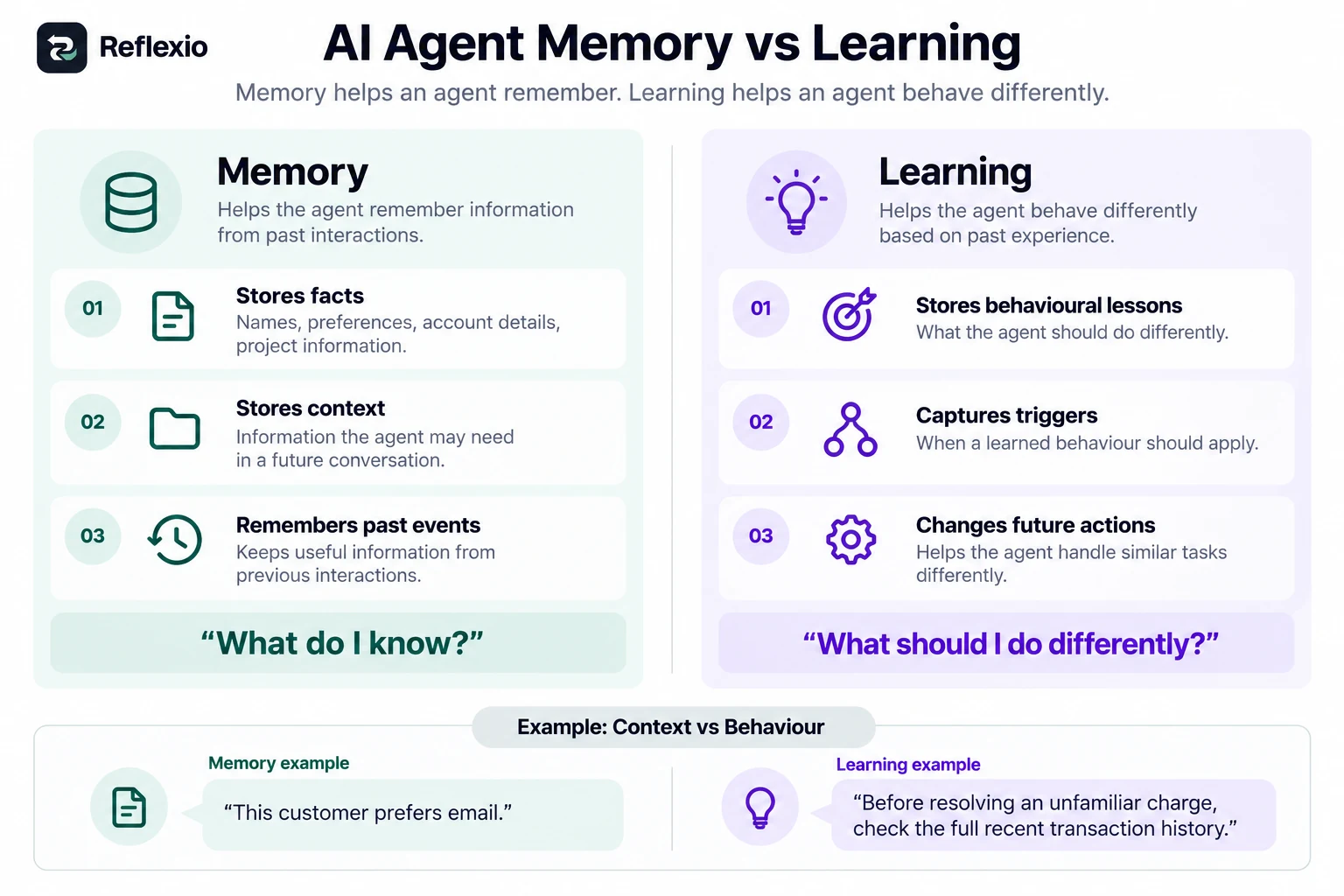
| Memory | Learning |
|---|---|
| Stores useful context | Changes future behaviour |
| Remembers facts | Captures procedures |
| “This customer uses X.” | “When X happens, check Y first.” |
| Helps maintain context | Helps improve execution |
| Answers “What do I know?” | Answers “What should I do differently?” |
This distinction becomes important when building AI systems. If an agent keeps making the same mistake, simply adding more memory may not solve the problem.
Why retraining the model is not always the answer
Retraining or fine-tuning can change model behaviour. But production teams often need something faster and easier to inspect.
Imagine a customer support team discovers that its refund policy changed from 30 days to 14 days. You may not want to retrain a model just to update that behaviour. You may want the agent to use a new rule or playbook instead.
There are several ways to improve an agent:
Model training
Changes the model itself. This can be useful when you need a broad capability change.
Prompt or instruction changes
Changes what the model is told to do. This is simple, but manual changes can become hard to manage as the number of rules grows.
Runtime behavioural learning
Keeps the model in place while changing the guidance and context used during future tasks. This is useful when the agent needs to learn from real production experience without changing the model weights. For a broader look at what this means in practice, see what a self-improving agent means.
How to prevent AI agents from repeating mistakes safely
Learning from feedback sounds simple until an agent starts learning the wrong lessons.
A safe learning system needs controls.
Scope: Who should receive the learning?
Trigger: When should learning be used?
Evidence: What interaction or outcome created it?
Evaluation: Did the learning actually improve performance?
Versioning: Has the learning changed over time?
Removal: What happens if the learning turns out to be wrong?
Without these controls, the learning store can become a pile of old instructions.
That can create another problem: prompt bloat.
The agent has more and more guidance but less clarity about which guidance matters. Reflexio addresses this by treating learned behaviour as something that can be evaluated, reviewed, updated and removed rather than treating every stored item as permanent truth.
How to measure whether an AI agent is actually learning
You should not measure learning by asking whether the agent “feels smarter”. Look at what changes in production. Useful signals include:
| Metric | What it tells you |
|---|---|
| Repeat error rate | Is the same mistake happening less often? |
| Human correction rate | Are users correcting the agent less often? |
| Task success rate | Are more tasks ending successfully? |
| Retry count | Is the agent taking fewer failed paths? |
| Tool calls | Is it becoming more efficient? |
| Retrieval relevance | Are useful learnings being retrieved? |
| Regression rate | Did a new learning cause another problem? |
The strongest systems compare the agent before and after a change and check whether the improvement holds across more than one example.
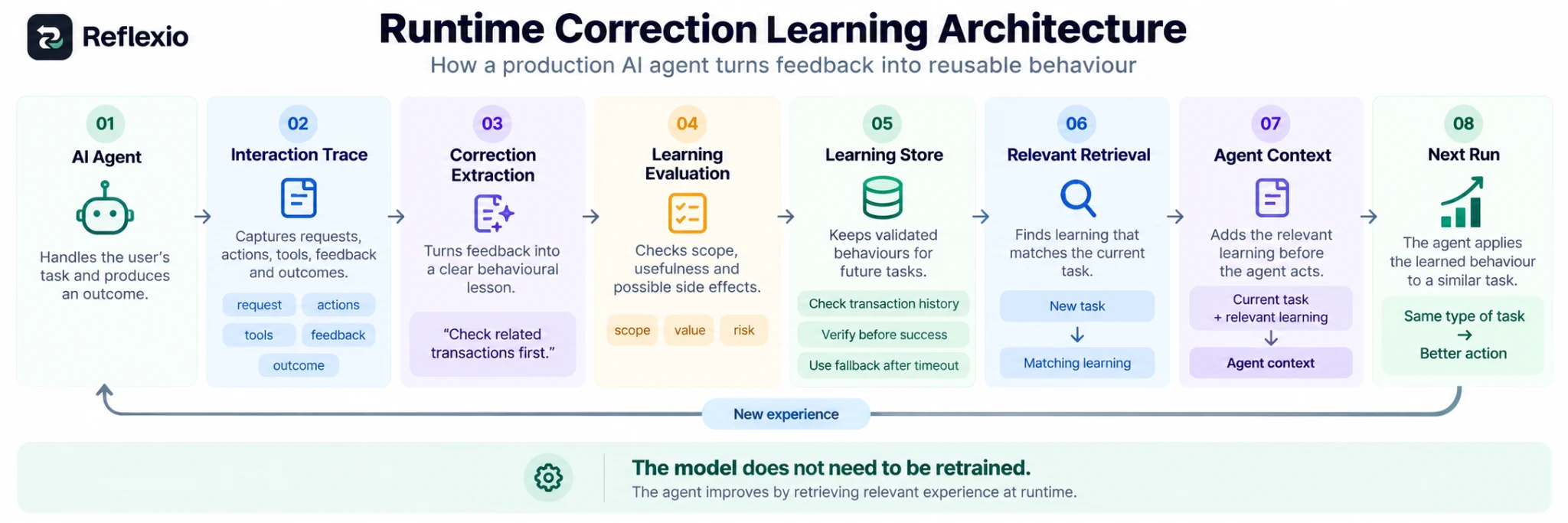
A practical architecture for correction-based learning
A simple production architecture can look like this:
-
Your AI agent
The agent handles the user's request and performs the task.
-
Capture the interaction
Record the request, agent actions, tool results, correction and final outcome.
-
Extract useful behaviour
Turn the correction into a clear lesson about what the agent should do differently.
-
Evaluate the learning
Check its scope, value and whether it actually improves the agent's behaviour.
-
Store the learning
Keep the validated learning so it can be used again.
-
Retrieve relevant learning
When a similar task appears, retrieve the learning that matches the current situation.
-
Add it to the agent's context
Give the relevant learning to the agent before it handles the task.
-
Better next run
The agent uses the learned behaviour to handle a similar task more effectively.
Where Reflexio fits
Reflexio is built as a learning layer around an existing AI agent. The agent still does the work. Reflexio adds the loop around that work:
Your agent
↓
Publish what happened
↓
Reflexio extracts useful learning
↓
Learning is stored
↓
Relevant learning is retrieved
↓
Your agent uses it on the next task
↓
Publish the next interaction and evaluate its outcome
The diagrams above illustrate a workflow that can include validation before reuse. Reflexio's default retrieval can include pending as well as approved learnings; outcome evaluation runs after eligible interactions are published. Teams can review learnings and reject those they do not want reused.
The integration does not require rewriting the whole agent. Reflexio supports a retrieve-and-publish loop through its SDK, REST API and CLI.
The important part is what happens after a correction. Instead of leaving the lesson inside an old conversation, Reflexio can turn the correction into actionable feedback with triggering conditions, evaluate its impact, and make relevant behaviour available when a similar task appears. That gives developers a way to move from:
“The user corrected the agent.”
to:
“The agent now knows what to do differently next time.”
Frequently Asked Questions
Can AI agents learn from user corrections without retraining?
Yes. An agent can improve through changes to the context, instructions, skills, playbooks or other runtime systems around the model. The key is to capture the correction, turn it into useful behavioural guidance, evaluate it and retrieve it when relevant.
How do AI agents learn from interactions?
The system captures an interaction, identifies useful feedback or failure signals, turns them into a learning, evaluates the learning and makes it available to future tasks where it applies.
Is learning from human feedback the same as RLHF?
No. RLHF, or reinforcement learning from human feedback, is a model training method that uses human feedback to help optimize model behaviour. Runtime agent learning can instead improve the system around a fixed model without changing its weights.
How can you prevent AI agents from repeating mistakes?
Capture repeated corrections, turn them into clear behavioural guidance, retrieve that guidance on similar tasks and measure whether the original mistake happens less often.
What is runtime correction learning?
Runtime correction learning is a way for an AI agent to use feedback from real interactions to change how it handles future tasks without necessarily retraining the underlying model.
The goal is not more memory. It is better behaviour.
An AI agent that can accept a correction once is useful. An agent learning from human feedback can turn that correction into a tested, reusable lesson that is much more valuable. The difference is what happens after the conversation ends.
The correction can disappear. Or it can become part of a learning loop that helps the agent handle the next similar task better. That is the shift from simply storing what happened to learning from corrections and changing behaviour over time.