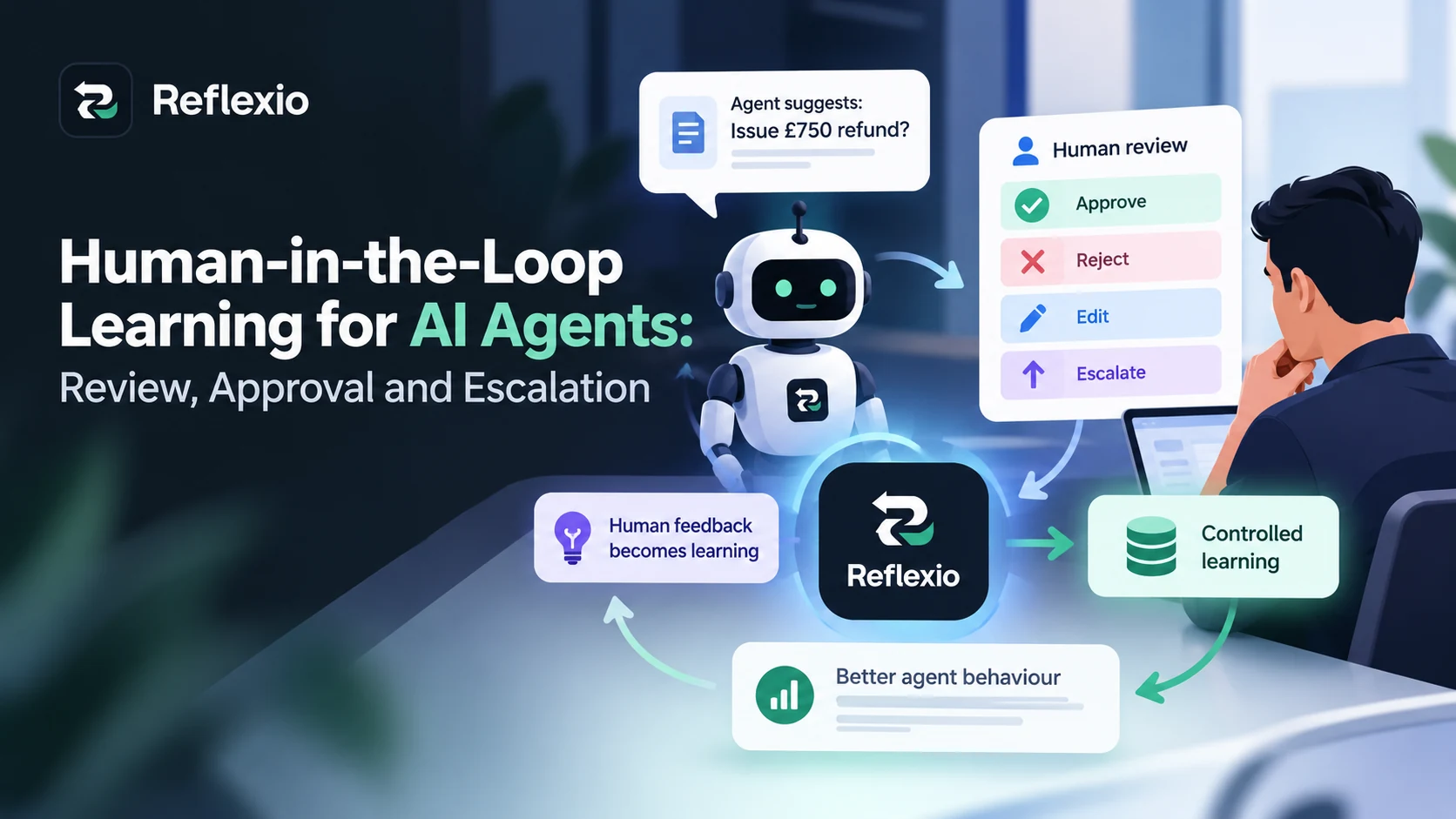
Your AI agent is ready to take action. Should it do it on its own? Should someone approve it first? Or should the case go straight to an expert?
As AI agents move from simple chat tasks to real work, these decisions become important. An agent may answer a product question without help, but issuing a large refund, changing an account or making a sensitive business decision is different.
The goal is not to put a person behind every action. The goal is to give the agent clear boundaries, bring people in when their judgement matters, and use their decisions to help the agent improve. That is where human-in-the-loop learning for AI agents becomes useful.
Where Should Humans Enter an AI Agent's Workflow?
Not every task needs the same level of human involvement. A useful starting point is to give an agent three levels of freedom.
Let the agent handle it
Use this for simple, low-risk tasks that the agent can handle reliably.
For example:
"What time does customer support close today?"
There is little reason to stop the agent for human approval.
Ask a human to approve
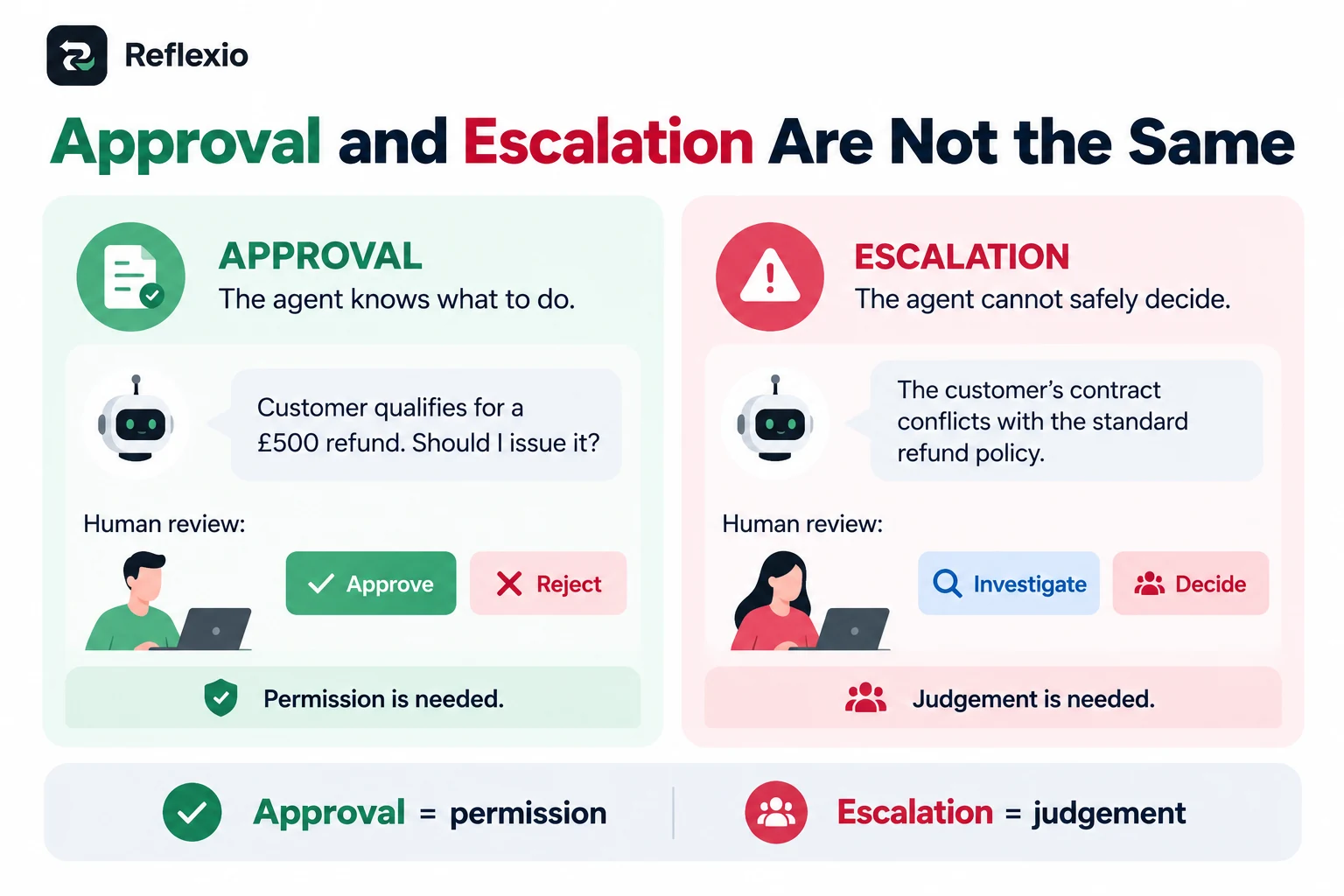
The agent knows what it wants to do, but the action has enough impact to require permission.
For example:
"The customer is eligible for a £500 refund. Should I issue it?"
The agent can prepare the action. A person makes the final call.
Escalate the case
Sometimes the agent cannot safely decide.
For example:
"The customer is asking for a refund, but their account has contract terms that conflict with the standard refund policy."
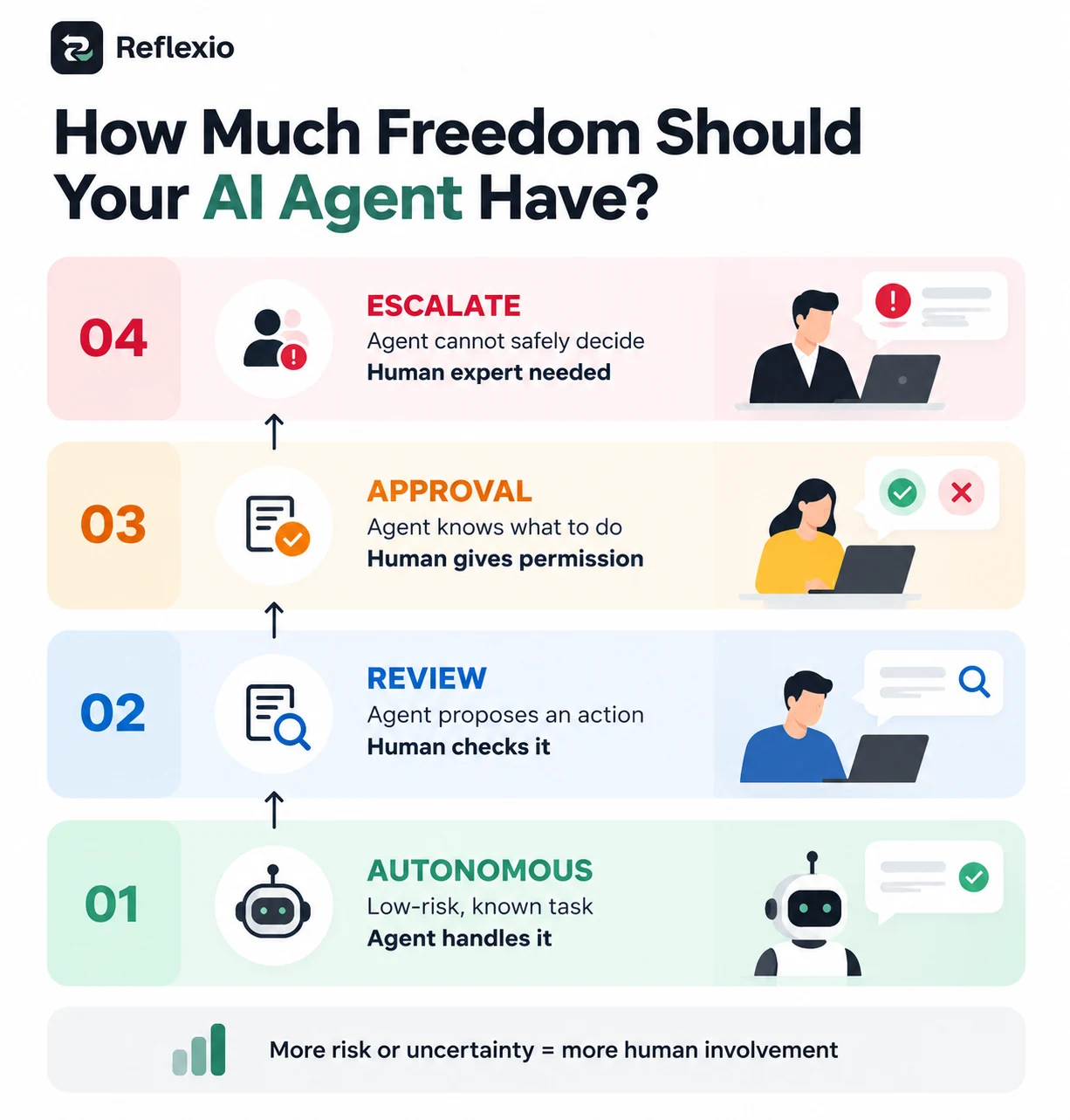
This is not simply an approval request. The agent needs someone with the right knowledge or authority to decide what happens next. Current guidance from Microsoft and Google Cloud recommends human review for high-impact actions and for situations where an agent needs human judgement or approval.
Approval Is Useful. Learning From It Is Better.
A basic approval workflow looks like this:
Agent → Human → Approve or reject → Task ends
That can keep risky actions under control, but it leaves an important question unanswered:
What does the agent learn from the human decision?
A stronger workflow looks like this:
Agent → Human → Approve, reject or correct → Useful feedback → Future agent behaviour
For example, an agent may recommend a refund.
A reviewer rejects it and explains:
"This customer has an enterprise contract. Check the contract terms before making a refund decision."
The immediate task is now clear. But the human has also provided useful knowledge about how the agent should handle similar cases. That is the difference between human oversight and human-in-the-loop learning. The first helps control an action. The second can help improve future actions.
Build a Human Review Policy Before You Build the Workflow
Before adding approval buttons or review screens, decide where humans actually need to be involved. Ask four simple questions.
How risky is the action?
A draft email and a bank transfer should not have the same level of control.
Can the action be reversed?
A wrong answer can often be corrected. A deleted record or completed payment may be harder to undo.
Does the agent have the right authority?
An agent may be able to recommend a refund without having permission to issue one.
How clear is the situation?
If the agent has conflicting information or does not know which rule applies, sending the case to a person may be better than forcing an answer.
Microsoft recommends approval for actions that affect people, money or compliance, especially when actions are difficult to reverse. It also recommends clear escalation paths for sensitive or unclear cases.
The result should be a simple policy:
| Situation | Agent behaviour |
|---|---|
| Low risk and well understood | Act |
| Moderate risk | Ask for review |
| High-impact action | Request approval |
| Unclear or conflicting case | Escalate |
| New or unusual situation | Ask for human guidance |
This prevents human review from becoming a bottleneck.
What Should a Human Reviewer Actually See?
A human cannot make a good decision if the agent only shows:
"Please approve."
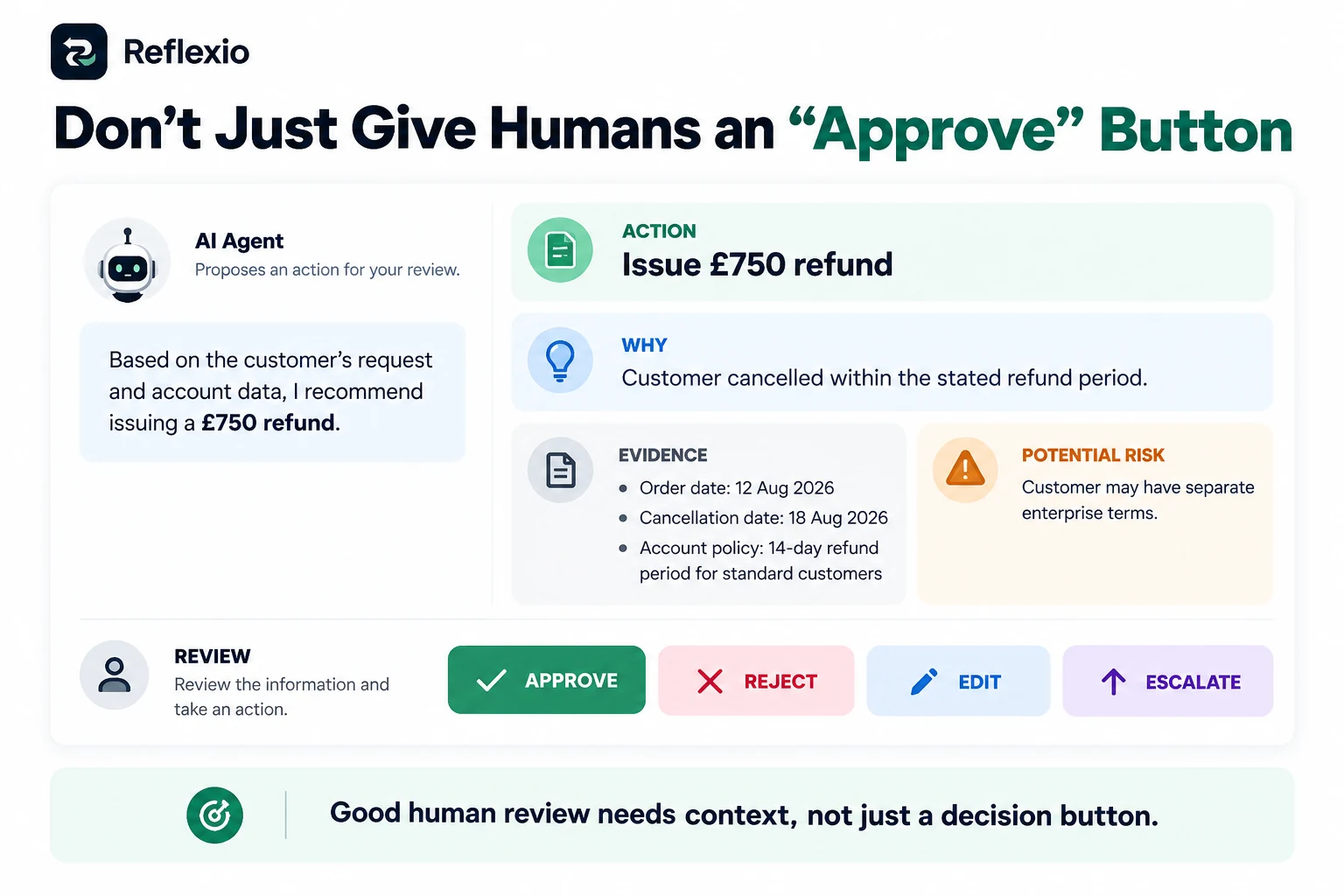
The reviewer needs enough information to understand what is about to happen. A useful review should show:
What the agent wants to do
For example:
Issue a £750 refund.
Why it wants to do it
For example:
The order was cancelled within the refund period.
What information supports the decision
For example:
Order date, cancellation date and account policy.
What could go wrong
For example:
The account may have a separate enterprise agreement.
What the human can do
- Approve
- Reject
- Edit
- Escalate
This makes human review faster and more useful.
Google Cloud describes human-in-the-loop workflows where an agent pauses at a defined point so a person can review, correct or approve its work. Microsoft's agent framework also supports approval required tools where an agent pauses before an action and continues after receiving human input.
Give Humans More Than an Approve Button
A simple yes or no is not always enough. Consider four types of human feedback.
Approve: The proposed action is correct.
Reject: The proposed action should not happen.
Edit: The agent is close, but something needs to change.
Escalate: The reviewer does not have enough authority or information and needs someone else to decide.
The edit option can be especially useful. Imagine an agent says:
"Refund approved because the customer is within the 30-day refund period."
The reviewer changes it to:
"Reject. This customer is covered by an enterprise agreement with different refund terms."
That is more useful than a simple rejection. It tells the system what was wrong and why. IBM's human-in-the-loop guidance similarly describes human input as a way to guide agent decisions, provide supervision and handle cases where automated decisions are not enough.
What Makes Human Feedback Worth Learning From?
Not every human decision should become a rule. This is an important part of building a safe learning system. Consider two examples.
"Use British spelling in my reports."
This may only apply to one person. Now consider:
"Check the contract terms before approving refunds for enterprise customers."
That may apply to a wider group of support cases. The system needs to understand the difference. Useful feedback should have enough context to answer:
- What happened?
- Why did the human make this decision?
- Who should this apply to?
- Is the decision specific to one customer or workflow?
- Does it conflict with an existing rule?
- Should it be used again?
This prevents a single human decision from becoming a rule that affects every customer.
Reflexio Turns Human Decisions Into Controlled Agent Learning
This is where Reflexio becomes the practical solution.
Reflexio is an AI agent learning platform that helps agents learn from real interactions, corrections and outcomes so useful behaviour can be reused in future work.
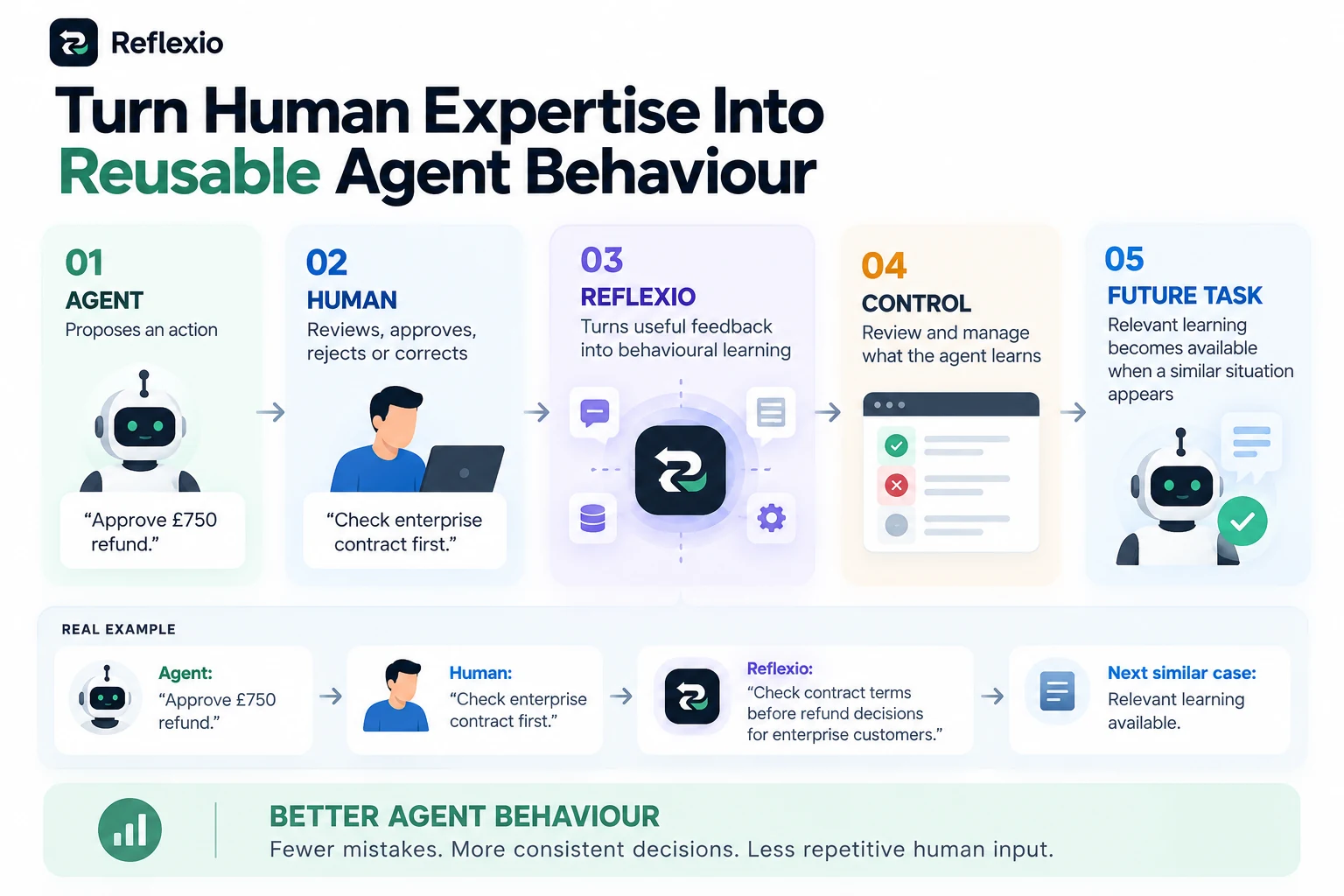
Instead of treating human review as the end of the process, Reflexio gives that feedback a place in the agent's learning loop. Consider the refund example again.
- The agent recommends a £750 refund.
- The human reviewer rejects the recommendation.
"Check the enterprise contract before approving a refund."
Reflexio
The interaction and correction can become a useful behavioural learning for the agent.
The next similar case
The agent can use the relevant learning when deciding how to handle the case. The important change is simple: Human expertise does not have to disappear when the review ends.
It can become useful guidance for future agent behaviour. Reflexio is designed as a learning layer around the agent rather than requiring teams to replace the agent itself. Reflexio AI agent learning platform works around publishing what happened, learning from it and making relevant learning available to future runs.
This also connects to Reflexio's open source AI agent self-improvement approach for teams interested in running and adapting the learning system themselves.
Keep Humans in Control of What the Agent Learns
Learning should not mean:
"Every human comment becomes a permanent rule."
That can create new problems. A production learning system needs control. With Reflexio, teams can review learned behaviour and reject rules they do not want reused. Default retrieval includes both pending and approved playbooks; approval is not a default gate before reuse.
If a team requires approval before a learning influences an agent, it must explicitly restrict retrieval to approved playbooks using agent_playbook_status_filter. With that approved-only filter, a useful workflow is:
Human feedback
↓
Candidate learning
↓
Review
↓
Approve or reject
↓
Controlled agent behaviour
This approved-only setup lets the agent learn from real work while people decide what should influence future behaviour. That matters when an agent works across customers, teams or business processes where one person's correction may not apply everywhere.
What Happens When Experts Disagree?
Human review becomes more difficult when two experts give different answers. Imagine:
Support manager: "Approve the refund."
Finance manager: "Reject it because the account has a different contract."
Which decision should the agent follow?
A useful workflow needs more than a list of human comments. It may need to consider:
- Who made the decision
- What authority they have
- Which policy applies
- Whether the feedback conflicts with existing guidance
- Whether the case needs further escalation
The agent should not simply learn the last answer it received. It needs to understand the context behind the decision. This is another reason to keep human feedback reviewable and controlled rather than treating every correction as permanent truth.
Human-in-the-Loop Should Change as the Agent Improves
As agents become more reliable, teams can move routine work towards automation while keeping humans focused on exceptions and high-impact decisions. Proven behaviour can then be reused across future tasks through repeatable agent execution.
For example:
At launch
Every refund requires human approval.
↓
After reliable results
Refunds under £50 can be handled automatically.
↓
Higher-risk cases
Refunds above £50 still require review.
↓
Unusual cases
Anything outside known patterns goes to an expert.
The aim is not to remove humans. It is to move human attention toward the cases where human judgement adds the most value. Over time, the agent can handle more routine work while people focus on exceptions, high-impact decisions and new situations.
When Should Your Agent Escalate?
A simple rule is to escalate when:
- The action has a high impact
- The agent does not have the required authority
- Information conflicts
- The case is outside the agent's known workflow
- The agent needs expert judgement
- A repeated problem needs investigation
The goal is not more human review. The goal is better human review. And when those human decisions contain useful lessons, they can become part of the agent's future behaviour.
From Human Oversight to Controlled Autonomy
Human-in-the-loop does not have to mean that humans are constantly stopping an agent. It can be a way to help an agent become more useful while keeping people in control of important decisions. The journey can look like this:
Human reviews more → Agent learns from useful feedback → Routine work becomes safer to automate → Humans focus on exceptions
That is the role Reflexio can play. Instead of letting corrections disappear inside old conversations, Reflexio helps turn real production experience into reusable agent behaviour.
If your team is repeatedly reviewing and correcting the same agent behaviour, the next step may not be another prompt. It may be a learning layer that helps the agent use what your team has already taught it.
Frequently Asked Questions
What is human-in-the-loop learning for AI agents?
It is a workflow where people can review, approve, reject or correct agent actions, while useful feedback can also improve future agent behaviour.
When should an AI agent require human approval?
Usually when an action has meaningful consequences, affects money or sensitive information, is difficult to reverse, or requires authority the agent does not have.
What is the difference between approval and escalation?
Approval means the agent knows what it wants to do but needs permission. Escalation means the agent needs human judgement because the situation is unclear, sensitive or outside its authority.
How does Reflexio learn from human feedback?
Reflexio can use interactions, corrections and outcomes to create reusable behavioural learning that can be reviewed and made available to the agent when relevant.