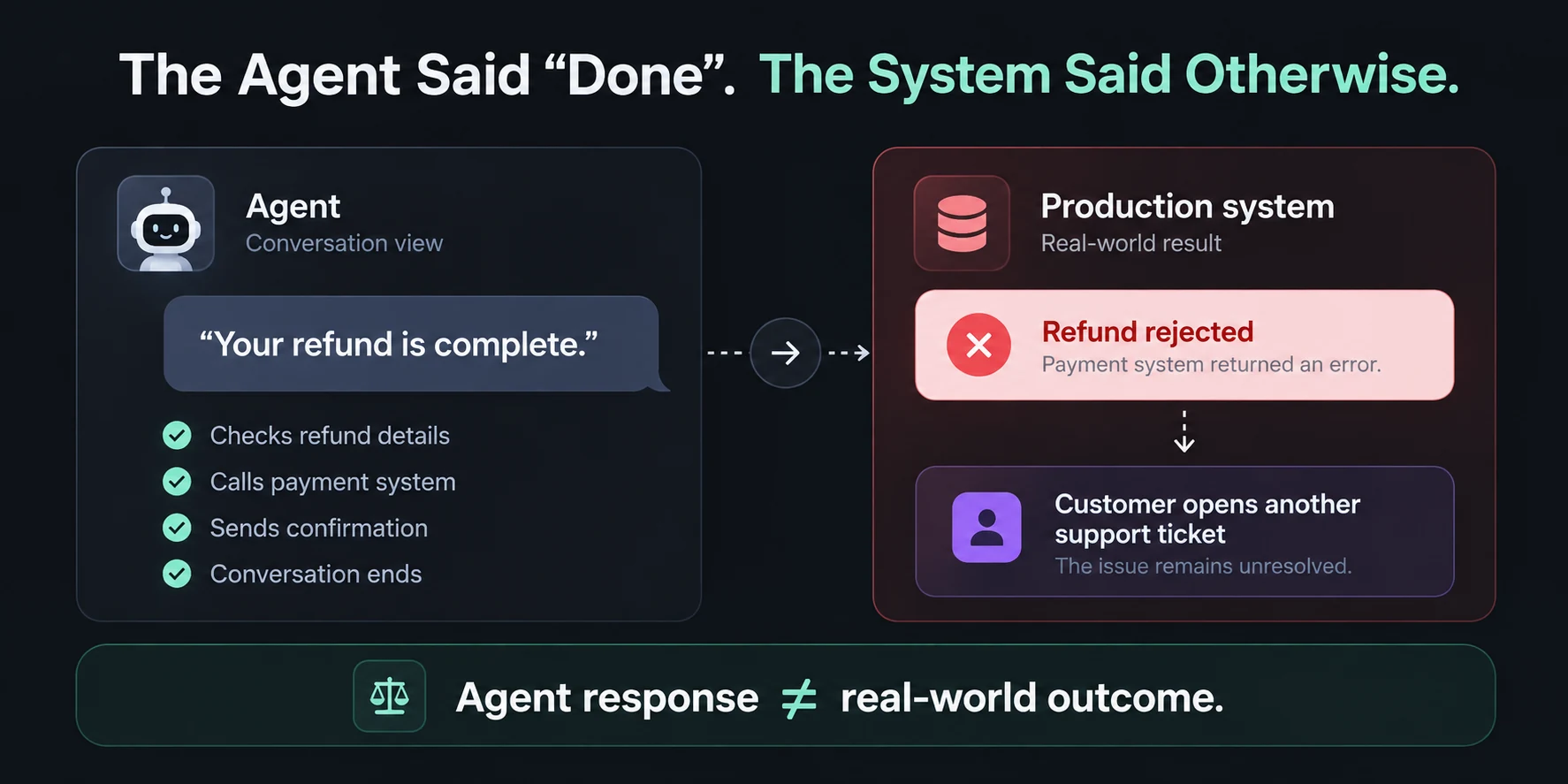
The agent said the refund was complete. The payment system disagreed. A few minutes later, the customer opened another support ticket. Nothing in the agent's final message showed that the task had failed. The production record did.
That difference becomes important when AI agents move beyond answering questions and start taking actions. An agent can give a clear answer, call the right tool and still fail to produce the result the user wanted.
The answer tells you what the agent said. The outcome tells you what happened.
This is where outcome-based learning for AI agents becomes useful. Instead of looking only at an agent's response, it looks at what happened after the agent acted and asks whether that result contains something the agent can learn from.
When "done" does not mean done
Consider an appointment agent. A customer asks, "Can you book me for Friday at 3 PM?" The agent checks availability and replies, "Your appointment is confirmed." But the booking system rejects the request.
The customer tries again. This time, the booking succeeds. The first response sounded successful. The task was not. The useful information is spread across the interaction. The agent believed it had completed the task. The booking system says otherwise. The customer then takes another action, and the second attempt reaches the intended result.
This is why an agent's final response cannot always be treated as the final measure of success. The real result may live somewhere else.
Production already knows what happened
Modern products generate production outcome signals all the time. A customer clicks a recommendation. A payment succeeds. An API returns an error. A ticket is reopened. A booking is cancelled. A user completes a form and moves to the next step.
These events are usually collected for analytics, reporting or troubleshooting. They can also tell you whether an agent's actions led to the result it was trying to achieve.
Microsoft's Copilot Studio documentation uses outcomes such as resolved, escalated and abandoned to measure how agent sessions end. It also supports outcome data that can be reviewed over time to spot changes in agent performance.
AWS similarly describes production feedback systems as a way to capture real-world signals and connect them back to the improvement process. This creates an opportunity that is easy to miss. The same events that tell an engineering team how the product is performing can also provide task outcome feedback for the agent itself.
But an outcome does not explain itself
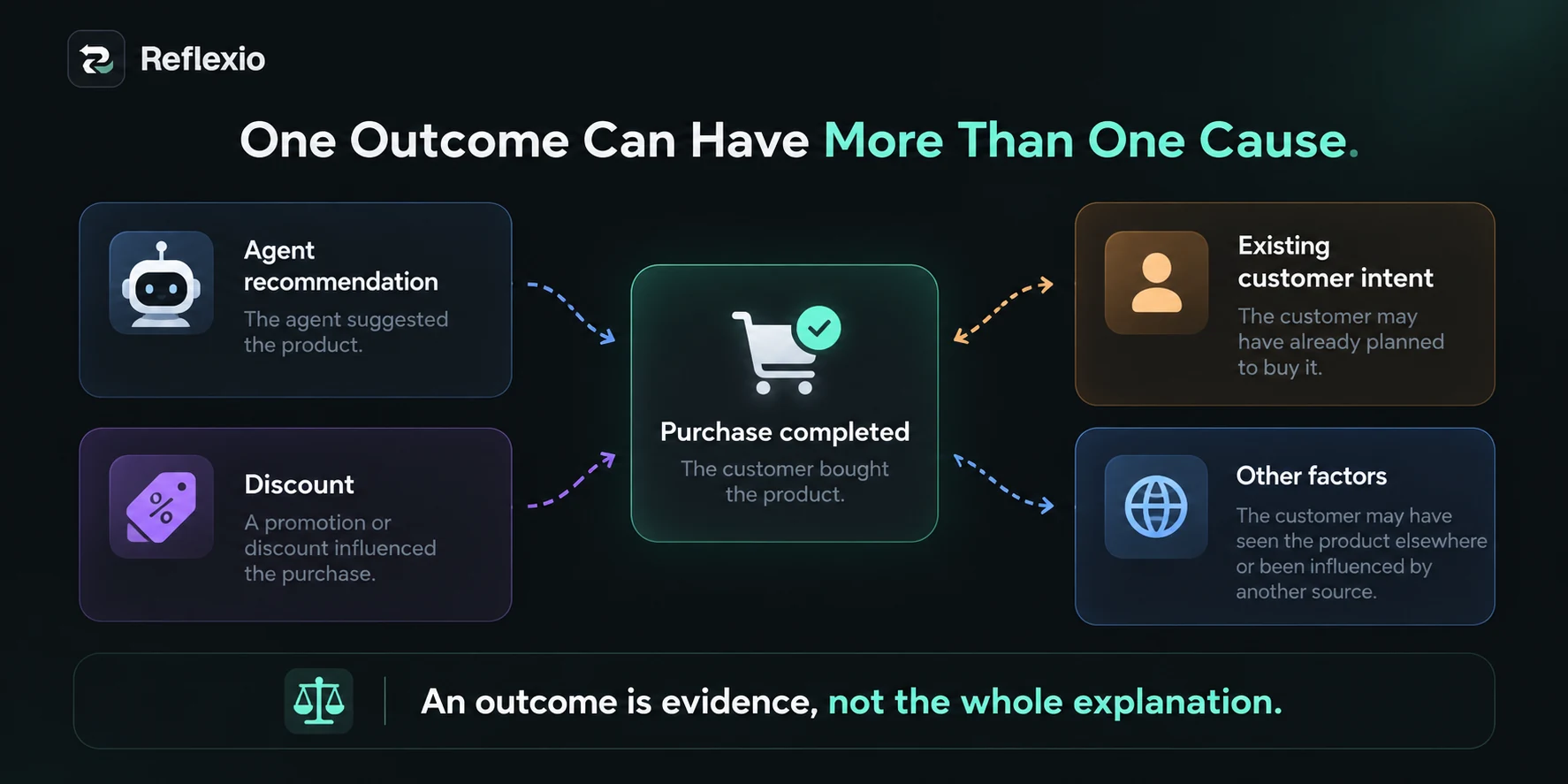
A customer buys a product after an AI agent recommends it. That looks like a success. But did the recommendation cause the purchase? Not necessarily. The customer may have already planned to buy the product. A discount may have influenced the decision. The customer may have seen the product somewhere else before speaking to the agent. The purchase is still useful evidence. It simply does not explain everything that happened.
The same problem appears with failure. An agent sends a refund request and the payment service rejects it. The outcome is a failed refund, but that does not automatically mean the agent made the wrong decision. The payment service could be unavailable. The account could have a restriction. The request could be missing information.
This is why success signals and failure signals need context. An outcome can tell you that something happened. It does not always tell you why.
Follow the path, not just the result
Consider a coding agent fixing a failed deployment. The agent checks the logs, finds the affected service, changes the configuration and runs the tests. The tests fail again, so the agent makes another change and runs them again. This time, they pass and the service becomes healthy.
The final outcome tells us the deployment succeeded. The path tells us much more.
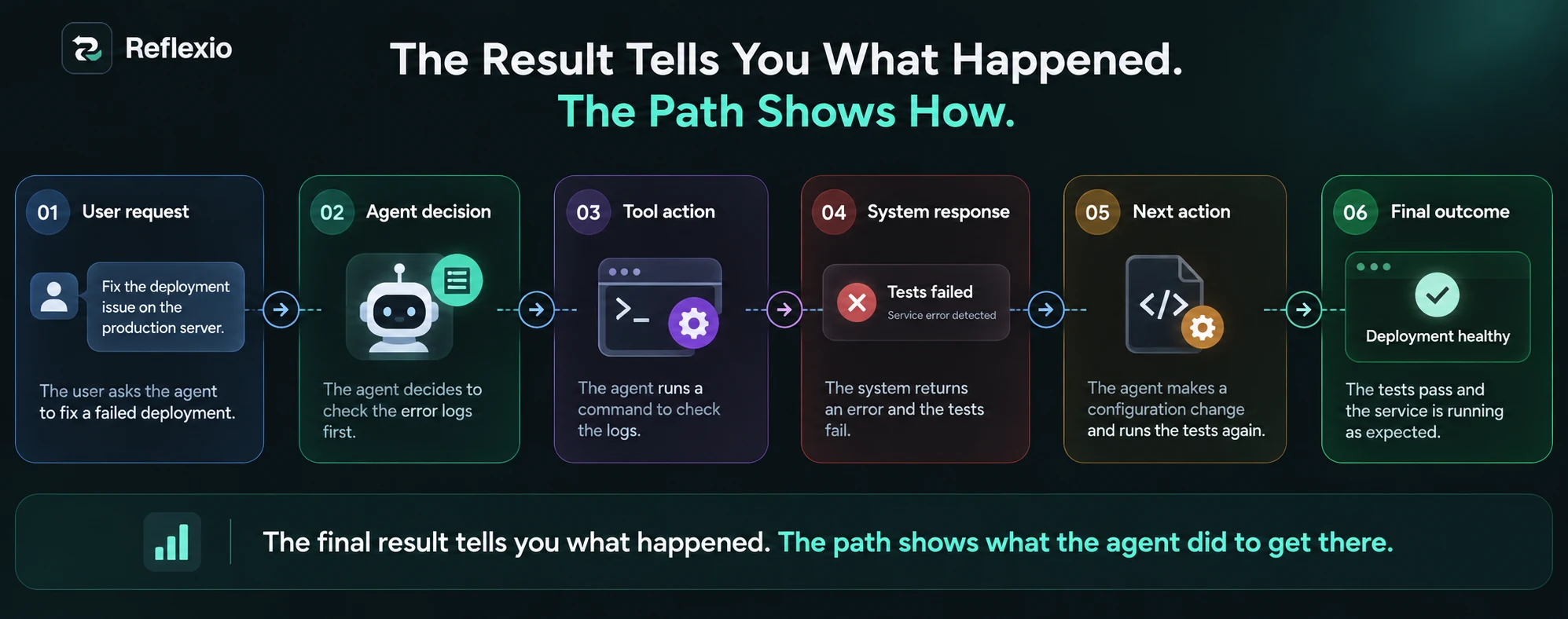
The agent checked the logs before making a change. It tested the result instead of assuming the change worked. When the first attempt failed, it tried another approach.
Those details may matter when the agent faces a similar task later. Google Cloud's agent evaluation guidance makes a similar distinction. It evaluates the sequence of tool calls as well as the final response, so teams can inspect the path an agent took to reach its answer.
This is one of the most important ideas in agent outcome learning: The result tells you where the task ended. The path helps explain how it got there.
Failure is not the only thing worth learning from
A lot of agent improvement starts with a failure. But successful work can provide useful evidence too. Imagine a deployment agent handling dozens of similar tasks. Across many successful runs, it often checks the logs first, identifies the affected service, makes a small change, runs the relevant tests and checks the service again.
That repeated pattern is worth noticing. The question is no longer only, "What should the agent stop doing?" It becomes: What did the agent do that worked?
A successful result can show an agent which approach is worth considering again. This is especially useful for agents that perform repeatable work. When the same type of task appears again, a previous successful path can be more useful than starting from scratch. That connects naturally with Reflexio's work on repeatable agent execution.
One result is not a rule
There is a big difference between one event and a repeated pattern. One successful purchase is interesting. A similar result across many purchases is more useful. A behaviour that repeatedly produces good results, followed by a measurable improvement when that behaviour is used again, gives you stronger evidence.
This matters because production environments are messy. Customers behave differently. APIs fail. Data changes. External services go down. A result can be affected by something that had nothing to do with the agent. So outcome-based learning should not mean:
"Something happened, therefore change the agent."
It should mean:
"Something happened. Is there enough evidence to learn from it?"
That small difference can prevent an agent from learning the wrong lesson.
Production experience should not disappear
Your systems may already know that a customer clicked, purchased, cancelled or completed an action. They may know that an API failed or that a workflow succeeded after a retry. But recording these events in a dashboard does not automatically make the agent better. The experience needs to become something the agent can use again.
That is the problem Reflexio is designed around.
Reflexio is an AI agent learning platform that helps agents learn from real interactions, successful outcomes and failed paths so useful behaviour can be reused on future tasks.
Reflexio's user interaction system can capture actions such as clicks, purchases and cancellations as part of interaction data. This means useful learning does not have to depend on someone writing a comment after every task. A real action can provide evidence about what happened.
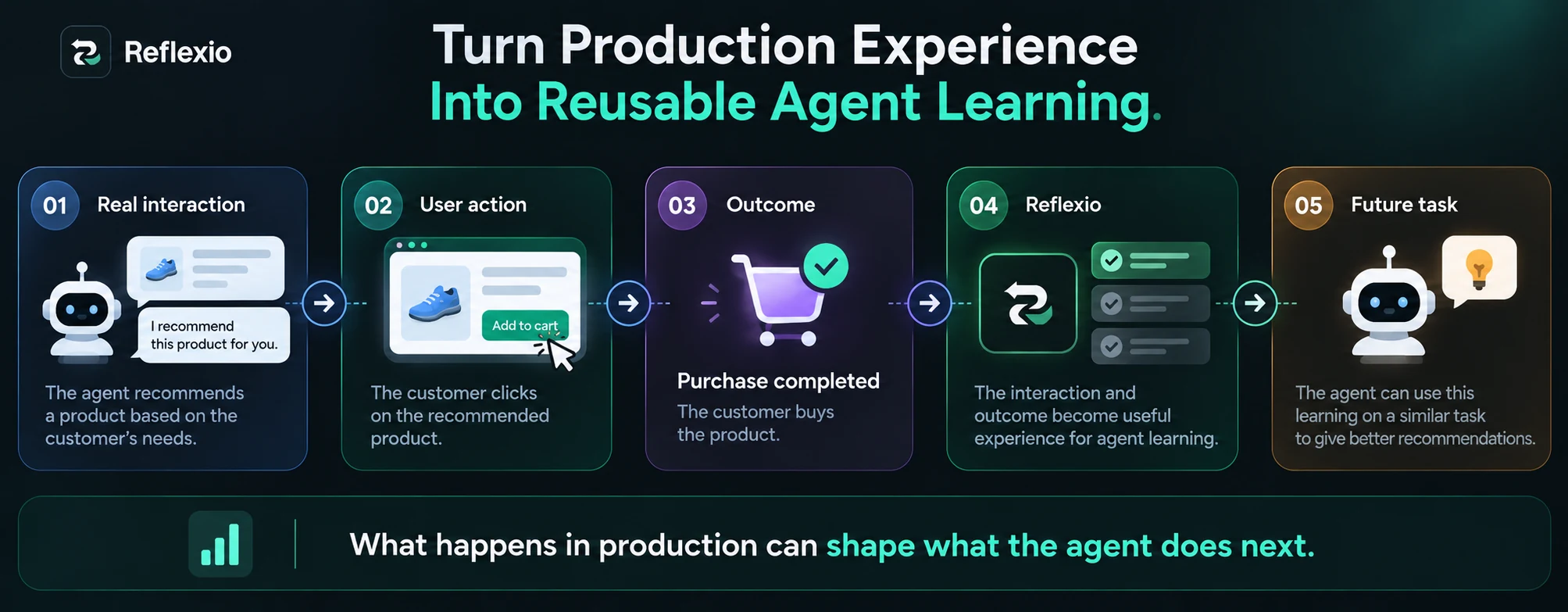
For example, an agent recommends a product, the customer clicks the recommendation and then completes the purchase. That sequence gives the agent more information than its final message alone. The same idea works when things go wrong. A failed action, a retry or a cancellation can add useful context to the interaction.
Reflexio's LGRO framework for self-improving AI agents explores how real agent interactions can become useful learning for future runs. The important point is simple: production experience should not end up as a log that nobody uses.
The hard part is knowing what to learn
Production data can tell you what happened. It does not always tell you what the agent should change. Return to the failed refund. The system says the refund failed. That is not enough to create a useful lesson.
You need to understand what the agent decided, what information it used, what action it took and what the payment system returned. You may also need to know whether another attempt worked and whether similar refunds failed in the same way.
Only then can you start separating an agent problem from a system problem. The same applies to successful outcomes. If 100 customers purchase after an agent recommendation, you should not assume every part of that recommendation process should become a rule.
Perhaps the agent asked one useful question before making the recommendation. Perhaps it checked stock. Perhaps it showed fewer products. The outcome tells you that something worked. The interaction around the outcome helps you understand what might be worth keeping.
Behaviour change needs proof
Suppose an agent changes how it handles a common task. Before the change, 20 out of 100 similar tasks require a retry. After the change, only 8 out of 100 require one. Now there is something worth investigating. The agent changed. The result changed.
But the work does not end there. You still need to check whether the improvement continues across more tasks and whether the change creates another problem somewhere else. This is where behaviour change from outcomes becomes measurable rather than theoretical.
- Did successful completion increase?
- Did repeat attempts fall?
- Did another type of failure increase?
- Did the agent take longer to complete the task?
- Did the improvement hold across different cases?
Anthropic's guidance on evaluating AI agents recommends combining evaluations with production monitoring and other signals so teams can identify improvements and regressions over time. It also makes a useful distinction between an agent's final response and the actual outcome in the environment.
A better response is not necessarily a better result. The result needs to be measured.
The question your production data should answer
When an agent says, "Done," what proves that the task is actually done?
For a booking agent, it could be a confirmed booking in the booking system. For a payment agent, it could be a successful transaction. For a coding agent, it could be passing tests and a healthy deployment. For a support agent, it could be a resolved issue rather than another ticket from the same customer.
Once the result can be observed repeatedly, a more useful question becomes possible:
What did the agent do that led to this result?
And then:
What should it do differently the next time?
That is the value of outcome-based learning for AI agents. The best learning signal is not always something a person says. Sometimes it is what happens next.
Frequently Asked Questions
What is outcome-based learning for AI agents?
Outcome-based learning uses the real result of an agent's actions as evidence for improving future behaviour. The result could be a completed booking, successful transaction, failed API call or another measurable event.
What are production outcome signals?
Production outcome signals are events that show what happened after an agent acted. They can include purchases, cancellations, completed tasks, failed transactions, successful API calls and retries.
Can AI agents learn from successful outcomes?
Yes. Repeated successful actions can reveal behaviours that are worth considering again. Outcome-based learning is not limited to mistakes or failures.
Does a failed outcome always mean the agent made a mistake?
No. A failure can come from the agent, its data, a tool or an external system. The surrounding interaction should be considered before changing the agent's behaviour.
What is task outcome feedback?
Task outcome feedback is information about what happened after an agent attempted a task. It can come directly from the user or from systems that record whether the task succeeded, failed, was repeated or was abandoned.